For the Australian Deer Association, the publication of Victoria’s 2025 recreational hunting study is more than a new set of figures. It is the result of years of advocacy for an up-to-date account of hunting’s contribution to the state and its regional communities.
The Sustainable Hunting Action Plan 2021–2024 identified a third economic survey as an important step. As the plan drew to a close, the ADA engaged with government to secure a commitment to the study. In December 2024, we received written confirmation that it would be undertaken in 2025, with the report then expected by July that year. The final report is dated 8 September 2026. We kept pressing for the work to reach publication because evidence is most useful when decision-makers and the community can see it and consider what it means, particularly in the lead-up to the Victorian election in November.
Now that evidence is available, we have plenty to celebrate. BDO’s study estimates that game-licensed recreational hunting contributed $559 million to Victoria’s Gross State Product and supported 3,703 full-time-equivalent jobs in 2025. Compared with 2019, the report estimates real growth of 24 per cent in GSP and 18 per cent in employment. Regional Victoria accounted for $401.6 million, or 72 per cent, of the total contribution.
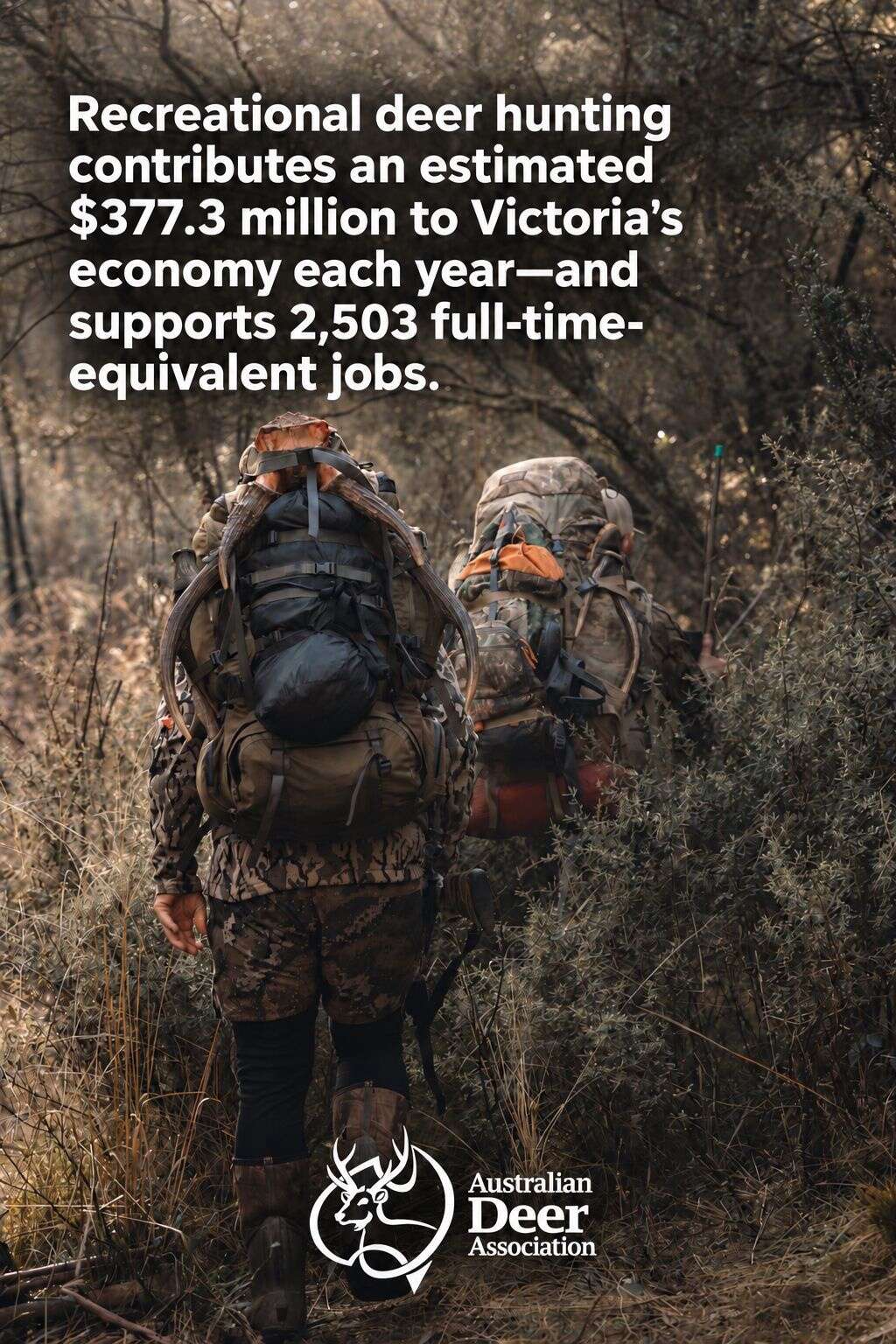
Deer hunting is central to this story. The study estimates that deer hunting contributed $377.3 million in GSP—about two-thirds of the total—and supported approximately 2,503 FTE jobs. Those figures reflect a substantial activity with strong links to regional towns, local retailers, fuel outlets, accommodation providers and other services. The report measures gross economic contribution: the activity supported by hunting-related spending.
The study also estimates that game licence holders contributed 2.2 million volunteer hours in 2025, including pest-control and conservation work. Its indicative valuation of those hours is $55.7 million. This is separate from the GSP contribution, but it helps show the wider involvement of hunters in regional and community life.
The report’s “Enabling participation” section brings together public-land access, Fishing, Hunting and Outdoor Victoria (FHOV), and the hunting-hut program. These priorities reflect the ADA’s strategic focus: participation depends on having places to go, practical coordination and information, and facilities that make time in the field safer and more effective.
Public-land access has been a sustained focus for the ADA. Our advocacy helped secure seasonal deer stalking across an additional 130,000 hectares in Errinundra and Snowy River national parks, effective from February 2026. Deer hunting has also become possible in Mount Cole State Forest following the revocation of the game sanctuary there. These gains expand opportunities for licensed hunters and strengthen the case for responsible, managed access to public land.
The passage of the Fishing, Hunting and Outdoor Victoria Act is another significant result of nearly two years of constructive ADA advocacy. The new authority gives hunting a clear place within Victoria’s broader outdoor recreation sector and creates opportunities for better coordination across government and the outdoor community. The legislation also establishes a Land and Aquatic Access Panel and strengthens the role of scientific research, regional data and practical field knowledge in decision-making. These are important foundations for improving access and ensuring hunters’ experience contributes to sound wildlife and land management. The next step is turning this framework into lasting, practical benefits for hunters and all Victorians who enjoy the outdoors.
The report also recognises the Government’s $1 million investment to build and upgrade remote hunting huts with secure meat safes. This is a direct result of the ADA’s sustained advocacy for better infrastructure to support safe and sustainable deer hunting. We highlighted the need for facilities that allow hunters to stay longer in the field, handle game more hygienically and make full use of the venison they harvest.
In remote areas and warmer conditions, game bags can be less suitable for extended trips. Secure meat safes can help protect and cool venison, supporting meat quality and food safety while giving hunters greater confidence that harvested meat can be brought home and used. The Government’s commitment to work with hunting and community groups on siting the huts is important: facilities will deliver most when placed where hunters need them and where they can support regional businesses and responsible deer management.
Together, public-land access, FHOV and Game-Changing Huts form a coherent strategy. Access opens opportunity; coordination helps make that access work; and practical facilities support safe, responsible participation. The report identifies access to land as a key enabler of hunting and one of the main barriers for people who want to do more. That finding reinforces why the ADA has continued to advocate in these areas.
As Victoria approaches the state election, this evidence should be part of the conversation with every party and candidate. We will continue to make the case for building on recent access gains, improving practical support for outdoor recreation and recognising the contribution responsible hunting makes to regional Victoria.
The report is an important milestone for the hunting community. We worked hard to see it commissioned and published because good decisions need good evidence. Its findings confirm the scale of recreational hunting in Victoria and the particularly significant contribution of deer hunting. We can be proud of that progress—and keep working to build on it.