FEATURE Jamie Howlett
Sambar hunting consists of a thousand small repetitions. Decisions, early mornings, wrong turns, and quiet victories that finally line up and let the right opportunity present itself.
My name is Jamie Howlett. I am 21 years old. I would like to share two stags that taught me those lessons, one that took the better part of a season to find on public land and one that reminded me why we hunt the country we do and practise for every scenario, close or far.
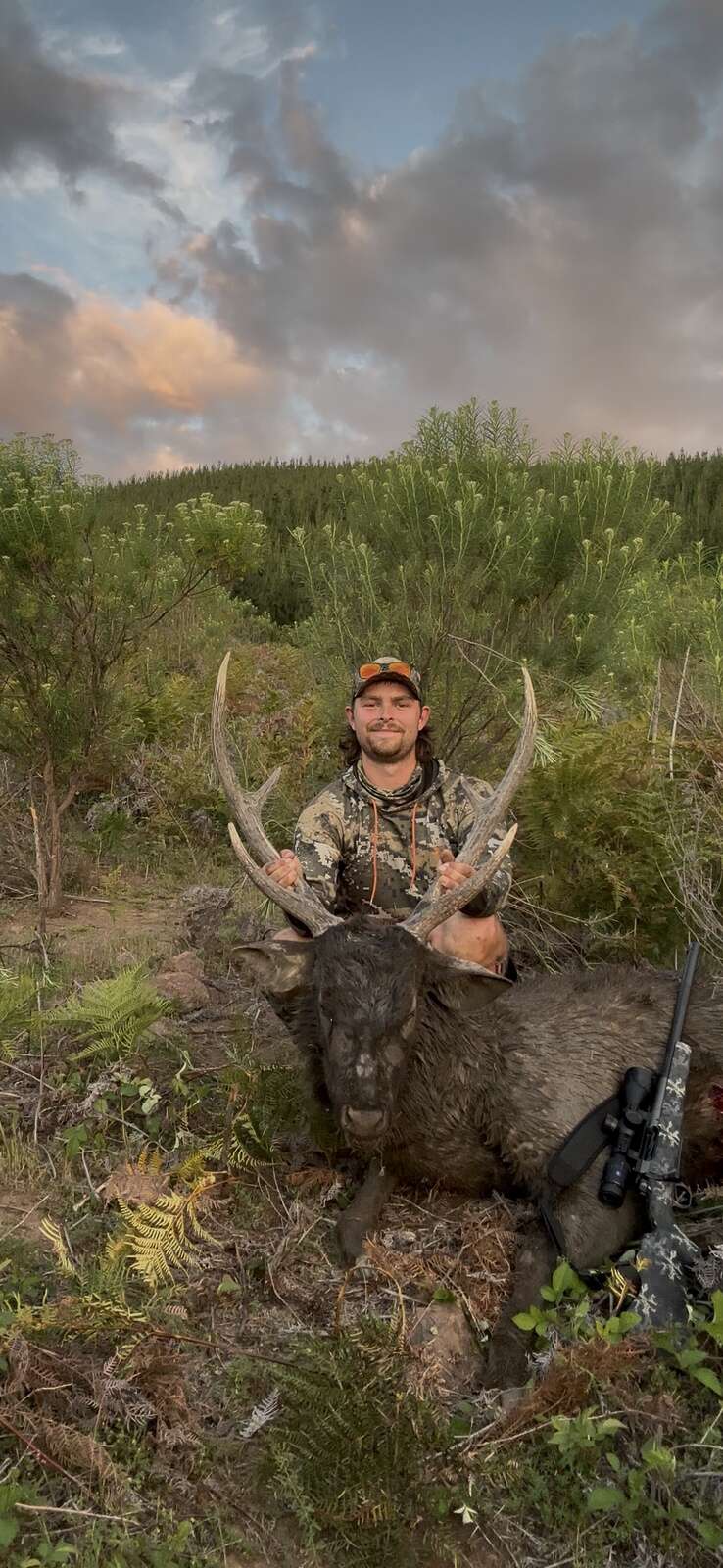
The first stag was a sambar of a size you do not often stumble across on public land, a 29-by-28-inch frame with a 26-inch spread. No, he was not a giant, but he was a prized trophy and a well-earned victory. He lived in a public state forest here in NSW, where I hunt whenever the opportunity is available.
I have tried to learn about the land by walking, because public land rewards patience and punishes shortcuts. Preparation was an important key to taking this stag. I spent a long period researching rifles before eventually settling on a Springfield Carbon Boundary chambered in 7mm PRC. This rifle matched what I wanted: consistency, lightweight handling, a calm bolt throw, and a barrel that was always true at distance.
Ammo was another obsession. For months, I hand-loaded rounds, tweaking and refining, chasing that tiny window where everything works together: brass, projectile seating, primers, powders and charges, and a projectile that flies straight and expands consistently. There were endless hours at the bench, the satisfaction of seeing consistent groups on target, and long-range testing that turned theory into confidence. I ran dozens of rounds at distance, recording results, adjusting zeros, and determining calculations.
Those preparations paid off on a solo four-day mission into the state forest. Late on day three, my eyes were peeled. I glassed through my binoculars, and there he was. He stepped into an open clearing just an hour before last light. You know those times when everything narrows and one form fills your binoculars. He was at 500 metres. I set up quickly but quietly, did the checks and calculations, and tried to breathe slowly. Yet I was still shaking, trying to hold the scope steady enough to pull the trigger.
The load I had carefully tuned with a 175-grain ELD X projectile connected. The stag did not make it more than 15 metres, but those were the scariest 10 seconds, worrying about the possibilities if he had kept going. Thankfully, he did not. He hit the ground hard, and that was when I knew I had made the shot. I remember the heavy thud even from that distance, an ending to months of planning.
I was full of excitement as I walked up to him. As I approached, I realised he was a lot bigger than I had expected. He was covered in mud, scars, and the beautiful coat that sambar carry with them. These are the moments we all aim for, when you get to sit down and admire what you have worked for and the true nature of these animals.
Many of us know that hunting public land is a much harder game, and there is a relationship that hunters share between the chase and knowing what it took to earn these rare moments.
I posted the stag to a Facebook group and appreciated the feedback. I also received a message from a fellow hunter who had trail camera videos of this stag. He was kind enough to send me the footage. It was amazing to see the stag in his wallow and the distances he covered from the cameras to where I had found him.
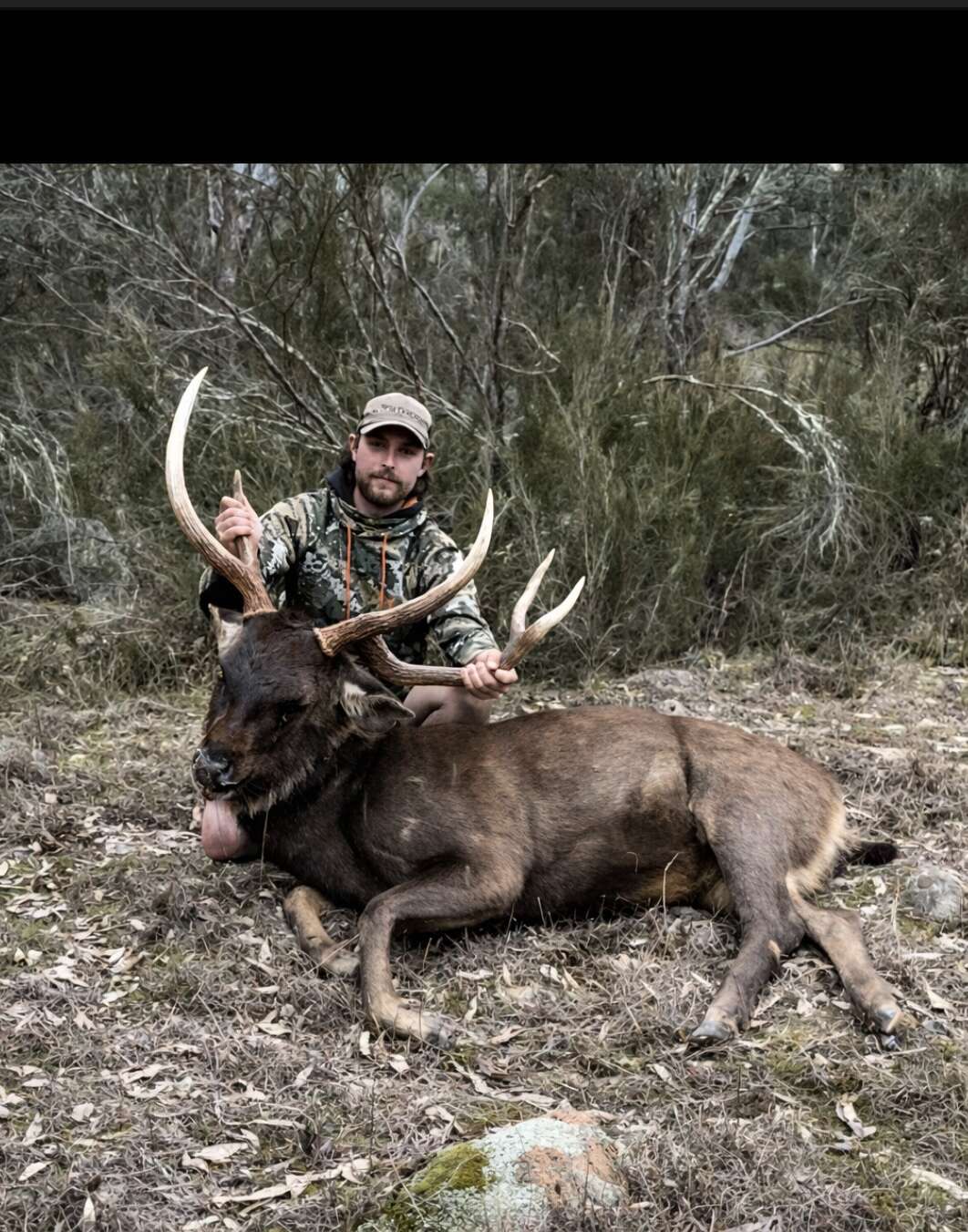
The second stag was a uniquely malformed beast, one of those animals that looks like it is carrying its life story on its head, with evidence of scars, cuts, many old injuries, and a lifetime of contests. He was scarred across his flanks and neck from earlier fights, clearly locked into battles with a 30-inch stag that I had taken two weeks prior, not more than 100 metres away. Where the first animal showed size, structure, and symmetry, this stag carried history.
This stag was not only different in shape, but different in hunting style. This was a close and slow encounter. I saw him at about 50 to 60 metres, and only the antlers were visible through scrub and grass, bedded up and protected. I was initially confused. I could not make out his full size. He looked large, but something just was not quite right. I thought there might have been two stags bedded together, but I could not decipher what I was seeing due to the shape and size. I made my approach.
It was mid-winter. I had to wade through a waist-deep creek in freezing cold water and then crawl the remaining distance as quietly as possible to get a clean line of sight within 8 metres. When I stood up, there he was. He locked eyes with me for a split second as I pulled the trigger.
When I finally got a good look at the deer, I realised why I had been confused about its actual size. It had large antlers, but they were growing in the wrong direction. They were truly malformed. One side only had two points, with brown tines well over 20 inches. The other side had antlers growing completely sideways. This was a first for me, seeing something like this. It was a unique and remarkable beast.
Both stags had different stories, one long shot, one short. They remind me of why we chase deer in this country. Hunting is not a single act; it is a relationship with weather, timing, hard work, and technique. The endless walks across public land, the quiet hours behind binoculars, the sessions of hand loading, and the long-range testing are what made it all so rewarding. Both left me grateful for the hunt and for the responsibility we carry as hunters.