FEATURE Ken Slee
Could Victoria’s hog deer be used to bolster endangered populations in the native range?
Introduction
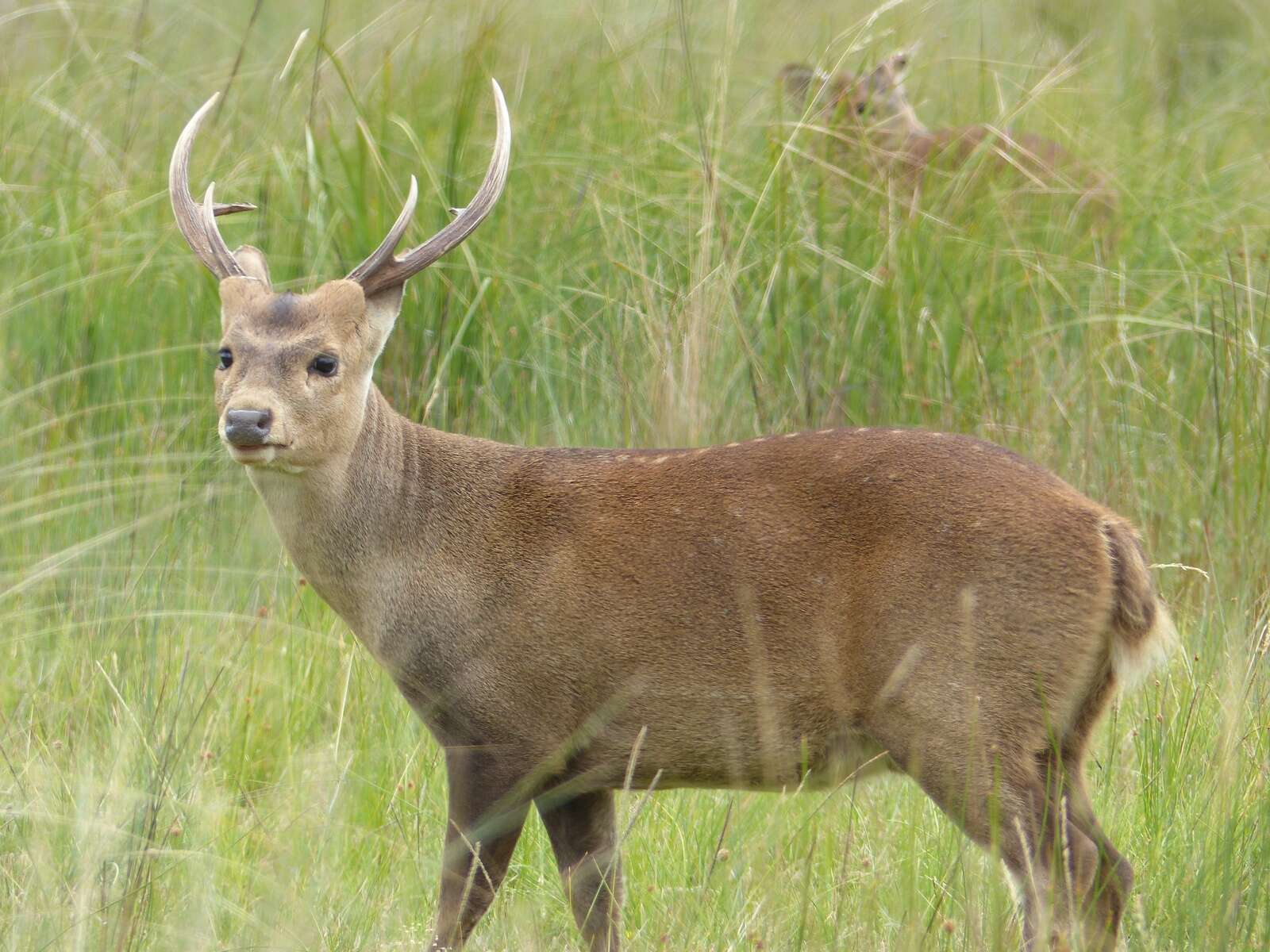
Hog deer are endangered throughout their native range in Asia due to a variety of issues including habitat loss, competition with livestock and illegal hunting. Victoria’s hog deer are therefore important for two reasons. The obvious one - as a valued hunting resource - but also because they could possibly be used to bolster endangered populations in their native range.
Because of their possible use in restoring hog deer populations in Asia, Erin Hill, at the Department of Ecology, Environment and Evolution at Latrobe University in Melbourne, led a research project to characterise the genetic make-up of Victoria’s hog deer using tissue samples that had been collected from animals shot during open seasons in coastal Gippsland.
In 2019 Hill and her associates published their findings in Ecology and Evolution. The most startling revelation from the research was that Victoria’s hog deer all carry mitochondrial DNA derived from chital deer – a finding that was totally unexpected as these animals show none of the physical attributes of this other species. Perhaps to be expected, the deer population also showed very little genetic variation, the result of a very small founding population. Despite these findings, it was concluded that Victoria’s hog deer may still be suitable for future translocations to their native range pending further investigation here in Victoria as well as in Asia.
From a hunting perspective, this research changes nothing, but it does raise the intriguing question of how, when and where our Victorian hog deer acquired their chital mitochondrial DNA. This article explores what we can deduce from this finding and how we might shine more light on the situation by the further genetic testing of deer both here in Victoria as well as in their Asian homelands.
Asian Hog Deer
Two subspecies of hog deer ( Axis porcinus) occur on the Asian mainland – A. p. porcinus in northern Pakistan, across northern India and through Nepal, Bhutan and Myanmar, and A. p. annamiticus in Manipur State in India as well as in Thailand, Laos, Cambodia and Vietnam. Both subspecies are in decline across their native range where they are classed as endangered.
A small population of hog deer also occurs in south-western Sri Lanka. The predominant view is that these deer are not native to the area but were introduced to the island, either by the Sinhalese themselves or during colonial rule.
Australia’s Hog Deer
Mayze and Moore (1990) in their book The Hog Deer record that the Victorian Acclimatisation Society imported 15 hog deer in the 1860s, of which six were identified as being from Sri Lanka, seven from India and two of unspecified origin. No-one has identified the subspecies of these deer but given their origins they probably belonged to A. p. porcinus.
Once in Australia these deer were held and bred successfully at the Acclimatisation Society grounds at Royal Park on the then northern fringes of Melbourne prior to liberations being made near Port Welshpool in 1865 and near Gembrook in 1871. The deer released at Port Welshpool were undoubtedly the founding stock for the population of hog deer that currently exists in coastal Gippsland. However, the Gembrook deer are said to have been quickly eliminated by farmers and timber workers although a remnant population may still exist in the headwaters of the Bunyip River.
Mitochondrial Versus Nuclear DNA
Before we can understand just what the findings of Hill and her associates mean, and how the origins of Victoria’s hog deer can be further investigated, we need to know a little about the two types of DNA and how they are transmitted through the generations.
Mitochondrial DNA (mtDNA) occurs within mitochondria, tiny structures within cells. This mtDNA encodes genes for energy production but does not determine an animal’s physical appearance or behaviour. Mitochondria, and therefore the mtDNA that they carry, are transmitted through the generations only via the female line.
Nuclear DNA (nDNA) is present in the nucleus of cells where it forms chromosomes. It carries the majority of an organism’s genetic information, encoding genes that determine features including physical appearance and behaviour. In contrast to mtDNA, the transmission of nDNA through the generations is via both the male and female lines.
Animal mtDNA evolves faster than nDNA and this trait makes it useful in the classification of deer and other animals and in defining their evolutionary history. Minor differences in mtDNA within a species (called haplotypes) can evolve over time and may be used to characterise or distinguish between populations.
The Implications
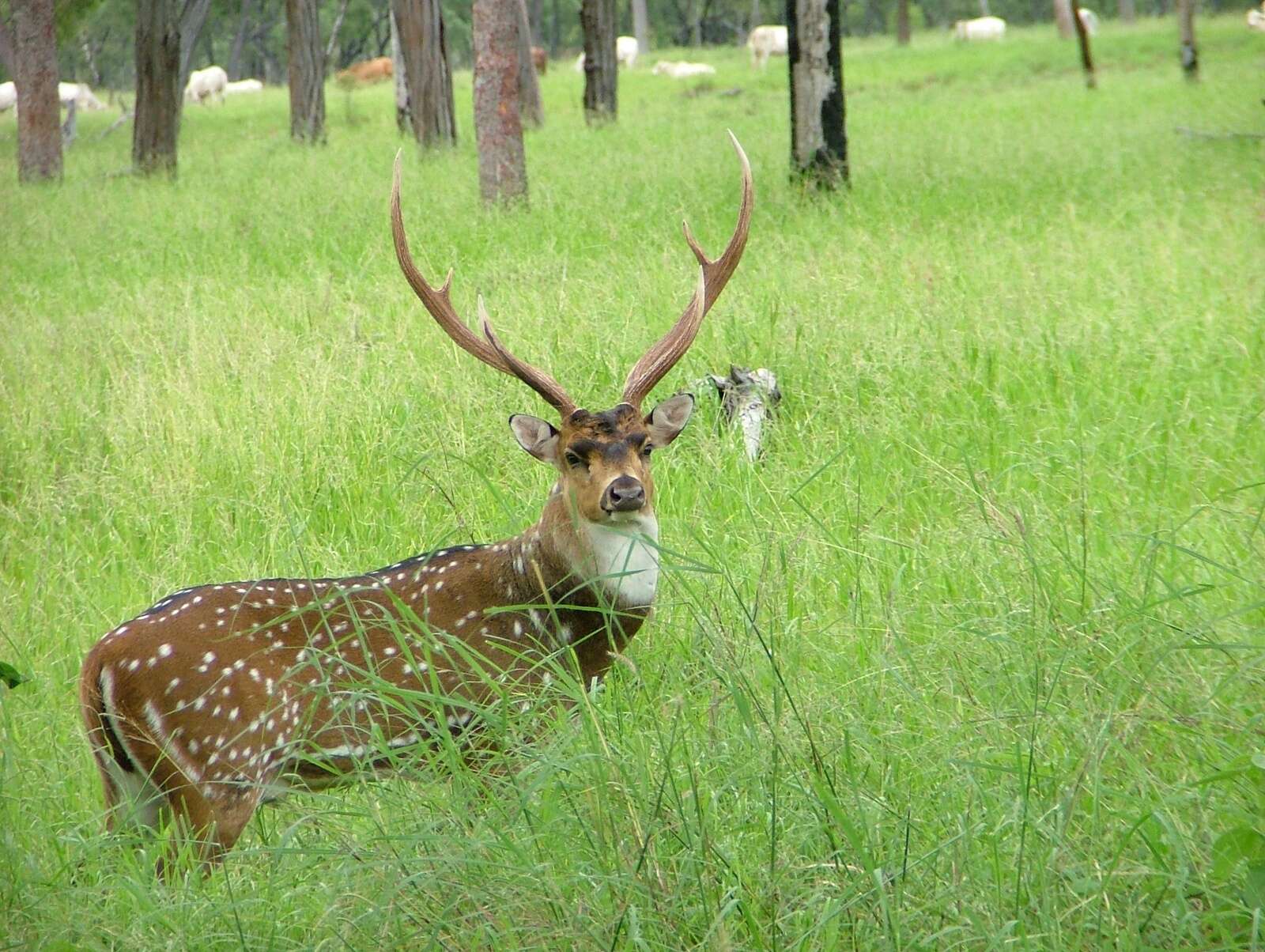
The question then is “How can our hog deer look like typical hog deer but all carry mtDNA from chital?” The explanation is that these two species are closely related, can cross-breed, and the progeny of such matings are themselves fertile and can breed. Carrying chital mtDNA does not change the physical appearance or behaviour of a hog deer as it is the nDNA alone that determines these features.
Given that Victoria’s hog deer contain mtDNA derived from chital, and this mtDNA is only transmitted via the female line, it follows that they must have all descended from an original mating between a chital hind and a hog deer stag, probably followed by several back-crossings to produce the physical and behavioural characteristics we would consider typical of the hog deer.
Hill and her associates suggest that this cross-breeding could have occurred via four scenarios:
How Likely are These Cross-Breeding Scenarios?
Firstly, it needs to be stated that all of the hog deer tested by Hill and her associates were from the dominant population in coastal Gippsland that originated from the Port Welshpool release and none were from the later release near Gembrook that may have represented differing genetic makeup.
Scenario 1 (cross-breeding after release) is most unlikely and can almost certainly be discounted – the Port Welshpool release was of nine successfully breeding hog deer hinds and three stags near where chital had been previously released by the Acclimatisation Society. It is implausible because cross-breeding has never been recorded in the wild and because it is unlikely that all nine of the released hog deer hinds then failed to breed successfully with a hog deer stag, but the three stags (or at least one of them) bred successfully with a chital hind or hinds and then produced numerous typical-looking hog deer progeny through back-crossing.
Scenario 2 (cross-breeding occurred in captivity at Royal Park) seems to be equally implausible for two reasons. At least nine of the 15 hog deer received from overseas were hinds and they were breeding successfully so that at least 20 animals could subsequently be released to the wild. It is also unlikely that chital hinds would have been allowed to mate with hog deer stags by the society’s managers at Royal Park.
Scenario 3 (cross-breeding in captivity in Asia) seems to be very plausible – holding the two species together in a confined area such as a zoo would likely maximise the opportunity for cross-species matings. Two possibilities then arise once animals arrive in Victoria:
Scenario 4 (cross-breeding in the wild in India and Sri Lanka where both species occur as wild populations) appears possible and can’t be excluded. However, hog deer and chital tend to occupy different habitats, and although cross-breeding is well known in captivity, cross-bred populations have never been recognised in wild deer where both species occur together. If inapparent cross-breeding was occurring in the wild in India and Sri Lanka, the chances that these rarer animals would be selected from among the wider population would also seem unlikely.
In all four of these, more-or-less likely scenarios, there is also the possibility that hog deer with chital mtDNA and a percentage of chital nDNA inheritance might be advantaged via greater breeding success or survival than other animals in the population. This could lead over many generations to the cross-breeds, and their chital mtDNA, coming to dominate in the population.
Further Potential Investigations
Clarifying how chital mtDNA came to be present in Victoria’s hog deer population may not be possible, but further research would certainly be of interest.
One avenue that could be pursued is to check the mtDNA of hog deer from the Bunyip River area to see if they also carry or carried chital heritage. If live animals or their droppings are no-longer available for testing, at least one mounted trophy from this population is known to exist and there may be others.
The hog deer of Sri Lanka have never been properly investigated and it would be informative to know the status of their mtDNA. Tissue samples or droppings are both suitable for such testing.
As there will be variation in the mtDNA (haplotypes) of chital populations across their native range, comparing the mtDNA carried by Victoria’s hog deer with that of chital in India and Sri Lanka could give an indication of where and when cross-breeding could have occurred.
Whether the hog deer imported to Victoria from India and Sri Lanka belonged to the A. p. porcinus or A. p. annamiticus subspecies remains in doubt. However, the work of Hill and her associates suggests that they are more likely to belong to the A. p. porcinus subspecies. Better defining their subspecies status would require a more extensive examination of their nDNA and comparison with that of the two described subspecies. Further testing could also potentially quantify the percentage of chital nDNA that our hog deer have inherited along with their chital mtDNA.
Does Mixed Genetics Matter?
There are two very different answers to this question depending on what we want to do with Victoria’s hog deer. If re-establishing or supplementing hog deer populations in their native range is contemplated, the genetic make-up of our deer is a key consideration. If, however, maintaining a population for recreational hunting is the goal, their history and genetics are largely irrelevant. Until we know more about the genetics of our Victorian hog deer there is a strong case for their ongoing management on both grounds.
References
Hill, E., Linacre, A., Toop, S., Murphy, N., and Strugnell, J. (2019) Widespread hybridization in the introduced hog deer population of Victoria, Australia, and its implications for conservation. Ecology and Evolution. 9: 10828-10842.
Mayze and Moore (1990) The Hog Deer. Australian Deer Research Foundation Ltd, Melbourne.